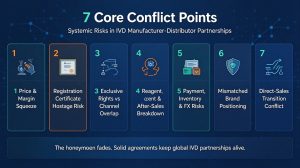
It often starts with big promises and ends in bitter disputes. The friction between IVD manufacturers and overseas distributors isn’t just about bad tempers—it’s a systemic clash across four critical dimensions: business models, profit distribution, regulatory ownership, and service capabilities.
Key Conflict Points
1. Price & Margin Squeeze
Manufacturers want profit margins to offset domestic volume-based procurement (VBP) pressures.
Distributors demand higher margins to compete in the market while facing severe local price suppression.
The Result: Cutthroat price wars among competing brands destroy market trust and leave distributors jumping to the cheapest supplier.
2. The Regulatory “Hostage” Situation
To save time early on, manufacturers often allow local distributors to hold the product registration certificates (AR/BRH).
When the partnership sours, the distributor refuses to transfer ownership, effectively locking the manufacturer out of the market (a frequent issue in Latin America, Brazil, Saudi Arabia, and Southeast Asia).
3. Exclusive Rights vs. Channel Overlap
Early stage: Manufacturers offer exclusive rights to secure coverage.
Later stage: If sales stall, manufacturers secretly engage secondary agents or direct channels. Distributors retaliate by cross-shipping, withholding end-user data, or hoarding spare parts.
4. Reagents & After-Sales Breakdown
Success in IVD relies on reagent repurchase, requiring robust engineering, quality control, and clinical support.
Overseas distributors often lack medical support capabilities, while manufacturers rely on a single sales manager and a WhatsApp/WeChat group. When issues arise, hospitals blame distributors, distributors blame manufacturers, and trust collapses.
5. Payment Terms, Inventory & FX Risks
Long credit terms (often 90–180 days for reagents and public hospital tenders) paired with currency fluctuations and customs delays turn strategic partners into hostile creditors overnight.
6. Brand Positioning Mismatch
Manufacturers start with low-to-mid-tier POCT or lateral flow assays and later try to upscale to Chemiluminescence (CLIA), Autoimmunity, or Integrated Automation requiring clinical advocacy and KOL training.
Distributors focused on quick, low-cost tenders lack the interest or capability to invest in academic marketing.
7. The “Direct-Sales Transition” Backstab
Once overseas revenues hit milestone targets, leading manufacturers transition toward setting up local subsidiaries, taking over major accounts, and demoting distributors to mere logistics providers.
To build long-term success, both IVD companies and distributors must structure clear agreements early.