Driven by volume-based procurement, tiered healthcare system and technological innovation, China’s in vitro diagnostic (IVD) industry is shifting from scale expansion to high-quality development, with domestic substitution entering an in-depth phase.
In terms of policies, the regular implementation of volume-based procurement and DRG/DIP reforms forces accelerated industrial consolidation. Profit margins of homogeneous low-end products are squeezed, and resources keep concentrating on leading enterprises with integrated instrument-and-reagent capabilities, while small and medium manufacturers are phased out. Biochemical diagnosis has largely achieved domestic dominance. High-end immunoassays such as chemiluminescence continue to break foreign monopolies. High-value tracks including molecular diagnostics, early cancer screening and companion diagnostics serve as major growth engines.
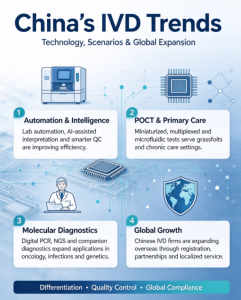
Technologically, automation and intelligence represent the main direction. Laboratory automation lines and “dark laboratories” are gaining popularity. AI large models are deeply integrated into sample preprocessing, result interpretation and laboratory quality control to improve testing efficiency. POCT products are developing toward miniaturization, microfluidics and multi-analyte combined assays, catering to primary medical institutions, chronic disease management and at-home self-testing scenarios. In molecular diagnostics, digital PCR and NGS technologies keep evolving, with expanding applications in infectious diseases, oncology and genetic disorder testing. The self-sufficiency rate of core upstream raw materials is steadily rising.
Application scenarios are expanding beyond hospital laboratories. Tiered medical care drives installation of IVD devices at grassroots facilities. Rising health awareness fuels demand for at-home testing and physical examination screening. Meanwhile, overseas expansion has become a key growth driver for major domestic IVD firms. Leveraging cost advantages and complete product portfolios, they accelerate overseas registration, channel building and localized services to offset domestic market pressure.
In the long run, competition will focus on clinical value rather than pricing. Future competition hinges on integrated testing platforms, differentiated innovative assays, independent upstream supply chains and global operation capabilities. Manufacturers with solid technology, strict quality control and overseas compliance capacity will enjoy stronger long-term competitiveness.